

Today, for Ukrainian business, financial sustainability is no longer just a positive balance sheet and the fulfillment of the sales plan.
It is the company’s ability to continue to operate, invest, and fulfill its obligations even when the external environment changes faster than the financial model.
The updated forecast of the Ministry of Economy predicts that Ukraine’s real GDP will grow by only 1.6% in 2026. At the same time, inflationary pressure, resource shortages, energy risks, and uncertainty with the external environment continue to directly affect the cost price and cash flows of companies.
Therefore, today we must answer not only the question: “How much will we earn?”
Much more important questions:
– What is the company’s liquidity reserve?
– How resistant is cash flow to a negative scenario?
– What expenses can be scaled or reduced without losing operational efficiency?
– Which investments create real added value, and which only freeze capital?
– How diversified are the sources of financing?
It is especially important not to go into a constant savings mode.
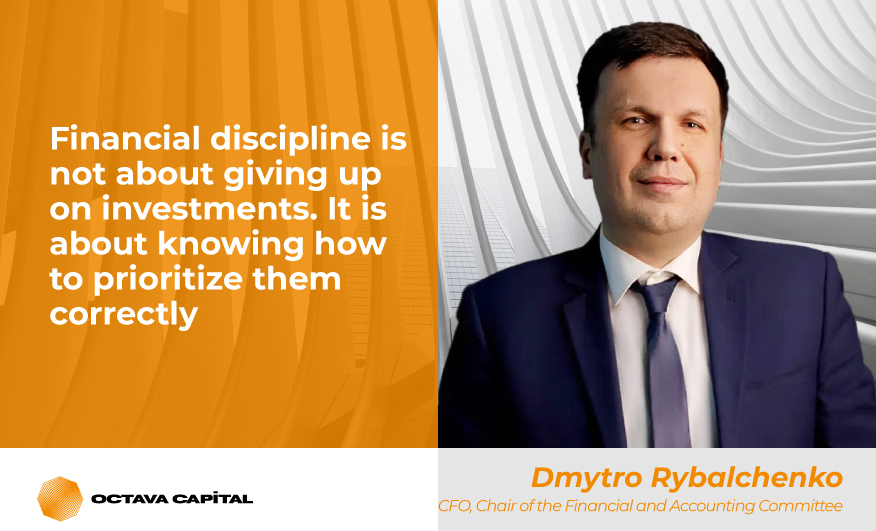
Financial discipline is not a refusal to invest. It is the ability to correctly determine their priority.
In war conditions, companies that maintain liquidity, control risks and at the same time invest in technology, people, energy independence and new markets have a much better chance not just to survive instability, but to use it as a point to strengthen their competitive positions.
That is why today’s financial strategy should be built not on the principle of “plan – fact”, but on the principle of “baseline scenario – risks – alternative actions”.